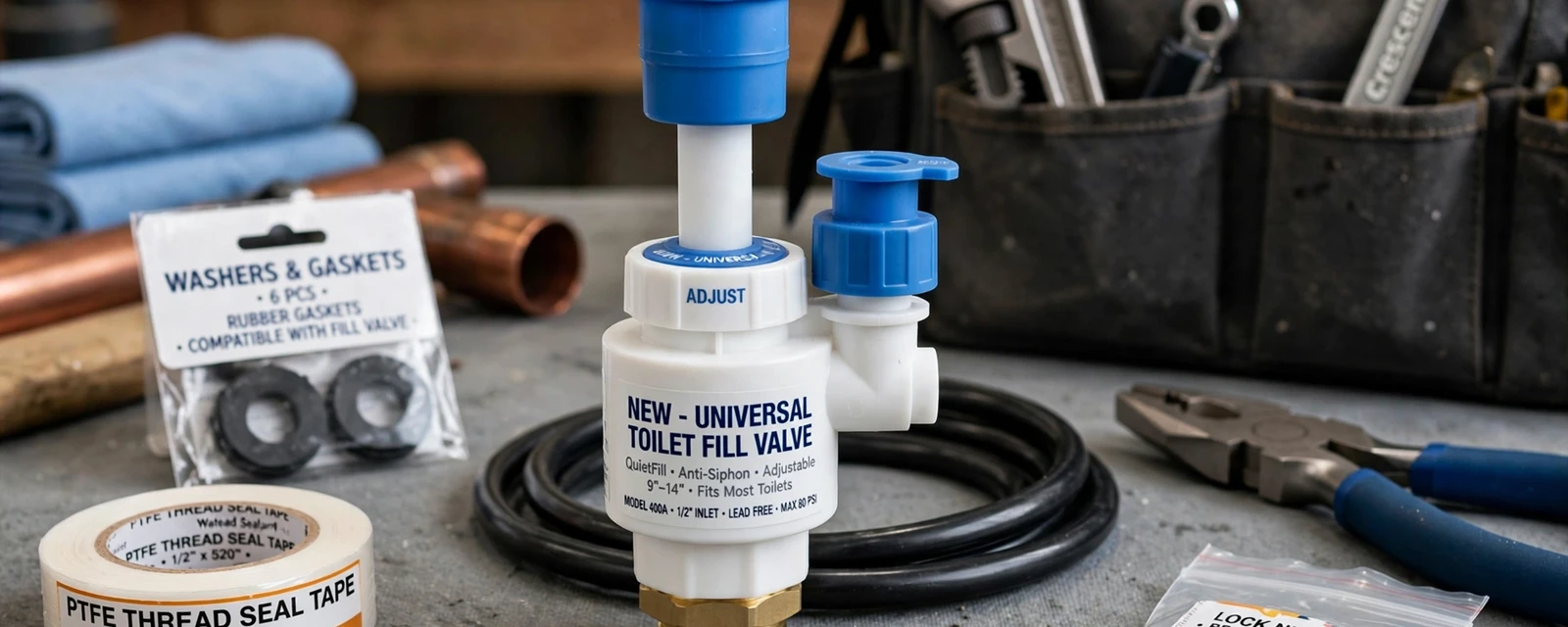
The short answer
The parts inside a toilet tank are the ones most homeowners can replace. A flapper, a fill valve and a supply line are low-cost parts and take little time with the right match. A leak at the base or a toilet that rocks is a different problem and needs a plumber.
Always shut off the supply valve first and flush to empty the tank. Our toilet repair page covers what a plumber does when the job goes beyond tank parts.
Replacing a flapper or fill valve
Bring the old part to the store so you can match it. Most flappers and fill valves are universal, though not all.
Turn off the supply valve
Turn it clockwise behind the toilet.
Flush and sponge out the tank
Empty as much water as you can.
Remove the old part
Unhook the chain and lift out the flapper, or loosen the nut under the tank for a fill valve.
Install the new part
Match the height and chain slack to the old one.
Turn the water on and test
Flush several times and watch for leaks.
Dixon water and what wears out tank parts
Source type: City of Dixon 2024 water quality report and permit handouts.The City of Dixon's 2024 report lists chlorine added at each water source and total hardness averaging 163 parts per million. Chlorine slowly degrades rubber flappers, and scale builds on the fill valve and seat.
The City of Dixon's permit handouts list repairing leaks in fixtures as exempt from a permit. They also cite CalGREEN, which sets 1.28 gallons per flush for new toilets. If the tank part you buy changes flush volume, the toilet should still meet the limit printed on its label.
Toilet work follows the California Plumbing Code, which is based on the Uniform Plumbing Code (UPC). Section 4.303 of CalGREEN, the California Green Building Standards Code, is the 1.28 gallon limit.
Symptoms that point to a part
The symptom tells you what to replace.
Runs on after a flush
A worn flapper or a chain that is too tight.
Hissing when the tank is full
The fill valve is not shutting off.
Weak flush
Low water level or mineral buildup in the rim jets.
Water on the floor behind the toilet
A cracked supply line or a loose nut.
Leak or wobble at the base
The wax ring or flange, which is a plumber's job.
Toilet leaking at the base?
Shut off the supply valve and call the 24/7 line. A same-day appointment is offered when available.
Tank parts or base work
A tank part is a simple repair. Base work involves the floor connection.
Reasonable at home
- Flapper and chain.
- Fill valve.
- Flush handle.
- Braided supply line.
Better for a plumber
- Wax ring and flange.
- A rocking toilet.
- Cracked porcelain.
- A clog that returns.
Choosing the right flapper
Flappers come in several sizes. Most older toilets use a two inch flapper, while many newer models use three inches. The wrong size will not seal. Take the old flapper to the store or look up the toilet's model number on the tank.
Rubber flappers wear out, and the chain length matters. Leave a little slack so the flapper can close fully. A chain that is too tight holds it slightly open and the toilet runs.
Replacing the supply line
Turn off the supply valve, flush and sponge out the tank. Unscrew the old line at both ends, using a bucket for the water in the line. Attach the new braided line hand-tight, then give it a quarter turn with a wrench.
Turn the water on slowly and check both ends for drips. Wipe them dry with a paper towel, which shows even a tiny leak. If the shutoff valve drips or will not close, replace it too.
Setting the water level
A fill valve that shuts off too low gives a weak flush. One that shuts off too high sends water into the overflow tube and the toilet runs. Most fill valves have an adjustment screw or a clip that sets the height.
The water should stop about an inch below the top of the overflow tube. Adjust in small steps, flush, and watch where the level settles. If the level will not hold, the valve itself may be worn.
Tools and parts to gather
Gather everything first so the toilet is out of service for as short a time as possible.
- A replacement flapper, fill valve or supply line that matches the old one.
- An adjustable wrench and pliers.
- A small bucket and a sponge.
- Towels for the floor.
- A flashlight to see inside the tank.
- Plumber's tape for threaded connections if the instructions call for it.
If you have a lot of mineral buildup, a little white vinegar and a brush help loosen old parts. Replace any part you disturb that looks cracked or hardened.
Testing your work
After the repair, flush at least five times and watch the base, the supply line and the tank for drips. Dry each joint with a paper towel and check it again after ten minutes.
Do the dye test the next day. If everything stays dry and the toilet no longer runs, the repair is done.
Keep the old parts until the repair is confirmed. If you bought the wrong size, you can compare them side by side at the store and exchange them without a second trip to guess.
A simple dye test for silent leaks
Add a few drops of food coloring to the tank and wait fifteen minutes without flushing. If color appears in the bowl, the flapper is leaking. A silent leak can waste a lot of water and may explain a higher bill.
If the dye test is clean and your bill is still high, the leak may be elsewhere. Our leak detection service looks for hidden sources. We serve Dixon, Vacaville and Davis.
Toilet part questions
There is no fixed schedule. Replace it when it leaks, shows wear or the toilet runs after a flush.
Often yes. Turn off the water, drain the tank and match the new valve to the old one.
A leaking flapper lets water seep into the bowl, so the fill valve turns on again.
The City of Dixon's handouts cite 1.28 gallons per flush under CalGREEN.
Call for a leak at the base, a rocking toilet, a clog that returns or any water you cannot stop.