The short answer
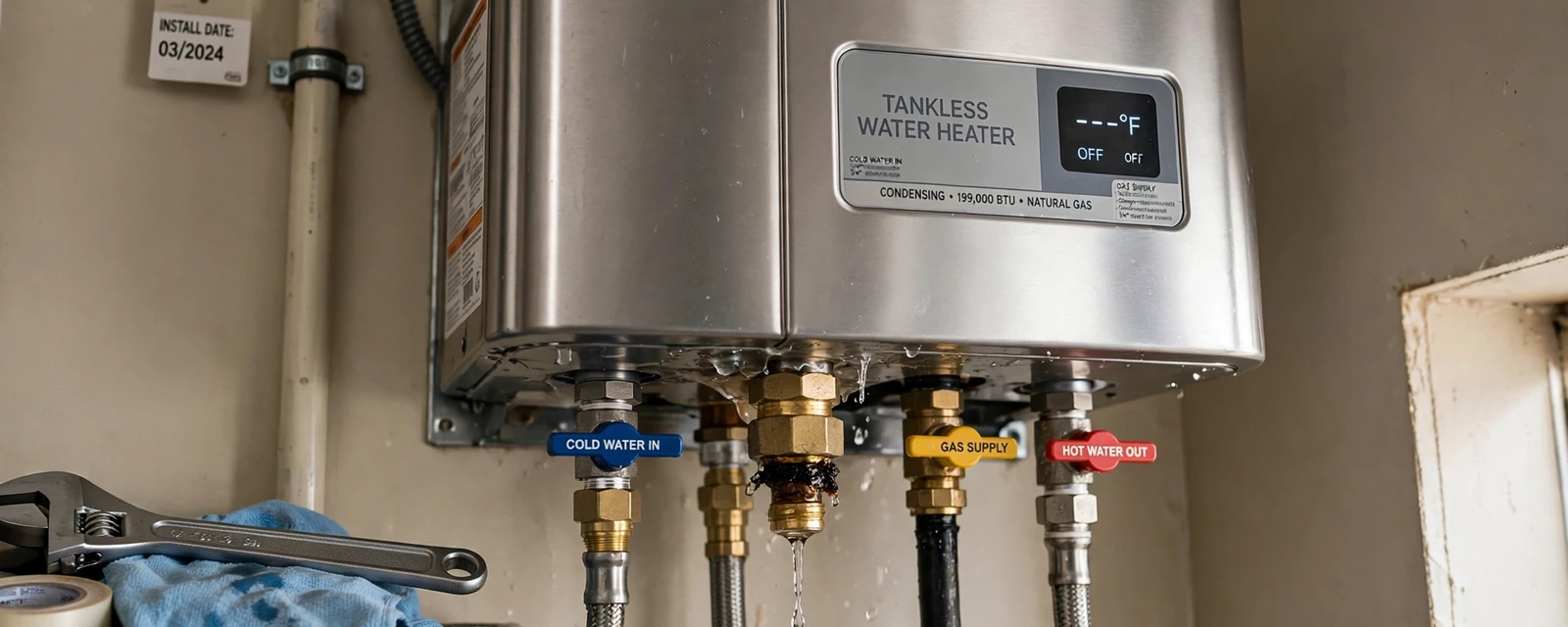
A tankless heater can leak. It does not hold a large tank of water, so it will not flood a garage the way a failed storage tank can. But leaks at fittings, valves or the heat exchanger can still damage the wall and the unit itself.
If you see water, turn off the unit, close the water supply to it and call. Our tankless water heater page covers service and replacement.
Where tankless leaks come from
The location of the leak points to the cause.
Water at the connections
A loose or worn fitting, a failed O-ring or a bad flex connector.
Water from the pressure relief valve
Pressure or temperature is too high, or the valve is worn.
Water inside the cabinet
A cracked heat exchanger or a failed internal seal.
Drips from the condensate line
Normal for a condensing model, unless the drain is blocked.
Water at the inlet filter
A loose filter cap or a cracked housing.
Why scale matters in Dixon
Source type: City of Dixon 2024 water quality report and Department of Energy guidance.The Department of Energy recommends flushing a tankless heater with a descaling solution in hard water areas. The City of Dixon's 2024 report lists total hardness averaging 163 parts per million, with a range of 130 to 190. That is hard enough to coat heat exchangers over time.
Scale narrows the water passages and raises temperature inside the exchanger. Over years, stress can open a seam or a joint. A regular flush is the cheapest way to protect the unit, and your plumber can set up service valves to make it simple.
The City of Dixon's water heater handout cites section 504.6 of the California Plumbing Code for relief valve discharge on storage heaters. Ask your installer which rules apply to a tankless unit.
Tankless heater leaking?
Shut it off and call the 24/7 line. A same-day appointment is offered when available.
What to do if you see water
Follow these steps in order. They keep the leak small until a plumber arrives.
Turn off the unit
Use the power switch or the breaker, or shut the gas valve for a gas model.
Close the water supply to the heater
Turn the shutoff valve to the unit clockwise.
Place a pan or towels
Catch the water and protect the wall.
Note where the water appears
A photo helps the plumber.
If you smell gas, leave the home and call 9-1-1.
Repair or replace
Most tankless leaks at a fitting are cheap to fix. Others point to the unit itself.
| Leak source | Usual fix | Replacement likely? |
|---|---|---|
| Fitting or flex line | Replace the part | No. |
| Relief valve | Check pressure, replace valve | Rarely. |
| Inlet filter | Reseat or replace the filter | No. |
| Heat exchanger | Replace the exchanger or the unit | Often, depending on age and warranty. |
Read the error code and the manual
Most tankless heaters show a code on the display when something is wrong. Look up the code in the manual. Some codes point to a flow or temperature issue, while others signal a leak sensor or a safety shutoff.
Write down the code and the model number before you call. It helps the plumber arrive with the right parts. Do not reset the unit repeatedly while it is leaking, since that can damage components.
A yearly service checklist
A yearly visit prevents many leaks. This is what it should cover.
- Flush the heat exchanger with descaling solution.
- Clean the inlet water filter.
- Inspect fittings, unions and the relief valve for drips.
- Check the vent and combustion air.
- Test the operation and the temperature setting.
- Record the date and any codes.
Questions to ask about warranty
Ask what the warranty covers and for how long. Heat exchangers often carry a longer warranty than parts and labor. Ask whether yearly service is required to keep it valid and who must perform it.
Register the unit if the manufacturer asks, and keep the installation receipt. If a leak does lead to replacement, these documents decide whether the cost is covered. Our water heater installation page explains how new units are set up.
When a tankless leak means replacement
A leak from a heat exchanger usually ends the life of the unit, especially if the warranty has expired. The cost of a new exchanger can approach the cost of a new heater, so a plumber compares both.
A leak from a fitting is a small repair. The key is knowing which one you have. A plumber opens the cabinet, checks for water trails and tests the unit. That inspection decides whether the heater has years left or has run its course.
Either way, shut the water off first. Our leak detection service also helps if the water you see is traveling from somewhere else.
How to avoid leaks in the first place
Most tankless leaks come from fittings that were loose at installation or from scale that was never flushed. Ask the installer to check every connection under pressure and to show you the service valves.
Then put the yearly flush on your calendar. With water as hard as Dixon's, that one habit prevents more trouble than any other.
If you are unsure whether the water is coming from the heater or from a pipe above it, dry the area and watch for new drops. Where the first drop forms tells you the source.
Protecting the warranty and the unit
Check the warranty before any repair. Many manufacturers cover the heat exchanger for a set number of years but require proper installation and maintenance. Keep records of flushes and service.
A leak is also a chance to review the install. Is the relief line routed correctly, are the shutoffs accessible and does the unit have the required clearances? We serve Dixon, Vacaville and Davis, and our water heater repair page explains the service process.
Tankless leak questions
Shut off the unit and the water supply right away. A small drip can wait for an appointment. A steady leak should be treated as urgent.
The Department of Energy says about 20 years with proper care.
Pressure or temperature may be too high, or the valve is worn. A plumber can check both.
The City of Dixon's 2024 report lists average hardness of 163 parts per million, which is hard enough that flushing is recommended.
The Department of Energy recommends flushing with a descaling solution in hard water areas. Ask your plumber for a schedule based on usage.