The short answer
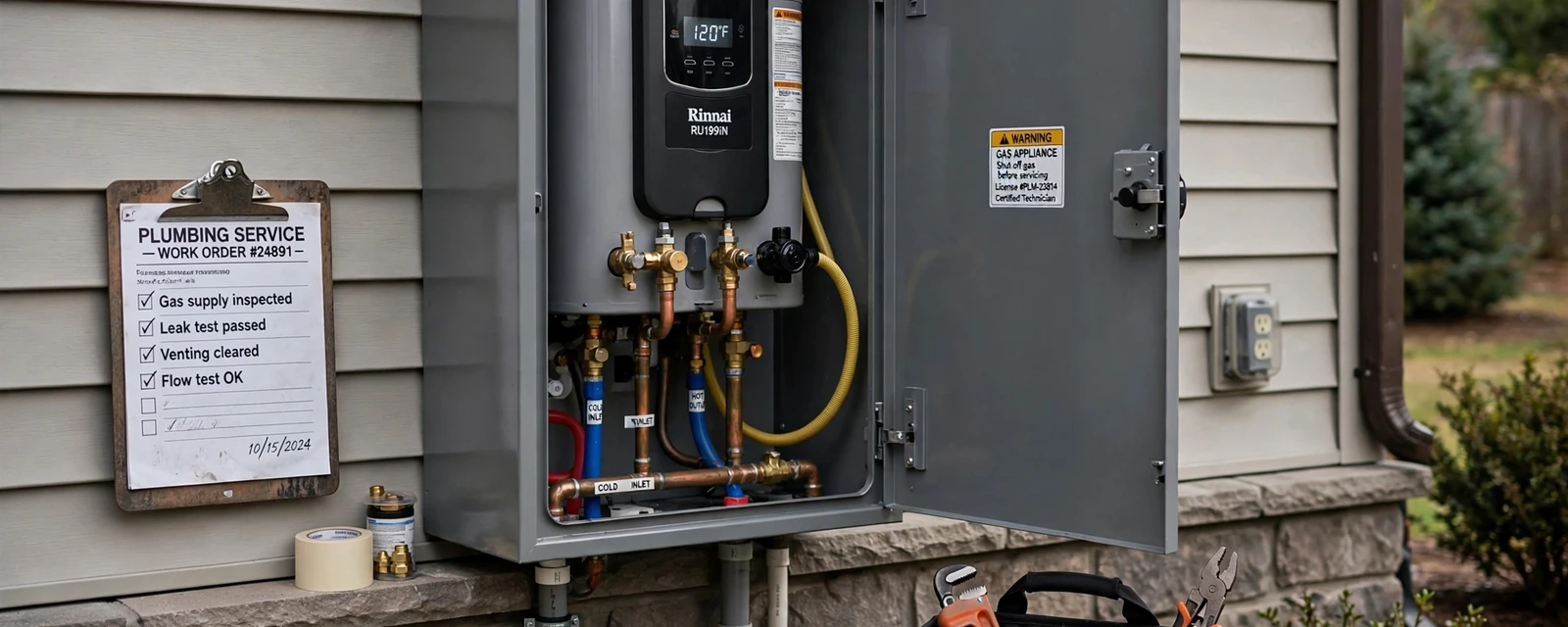
Yes, some tankless water heaters are made for outdoor mounting, and they are common in mild climates. The unit is rated for weather, vents directly from the cabinet and frees space inside. Dixon has hot summers and a few freezing nights a year, so freeze protection and sun exposure need attention.
The Department of Energy says tankless units last about 20 years, longer than a storage tank. A good install location is part of reaching that number. Our tankless water heater page explains how we handle these jobs.
Outside versus inside
Placement changes the work and the maintenance.
Outside installation
- Frees closet or garage space.
- Exhausts straight out, so no vent run through the house.
- Exposed to wind, sun and rain.
- Needs freeze protection for the water lines.
Inside installation
- Protected from weather.
- Needs a vent through the wall or roof.
- Uses indoor space.
- Often easier to service in bad weather.
Dixon climate and the outdoor decision
Source type: City of Dixon permit handouts and Department of Energy guidance.Dixon has a hot-summer mediterranean climate. Direct sun on the cabinet and 100 degree afternoons are normal for the Central Valley, so a shaded wall is a better spot than a south-facing one. Occasional winter frost is still possible, so exposed pipes need insulation or a heated trace.
The City of Dixon's instant permit path covers direct replacements of the same kind, function and capacity. Switching from a gas tank to tankless is not eligible, and it goes through a standard permit. The Department of Energy also notes that flushing a tankless heater with a descaling solution matters in hard water, and Dixon's hardness averages 163 parts per million.
Weighing a tankless install?
Call and describe where you want it. A same-day appointment is offered when available.
Checklist for an outdoor install
Use this list when you compare quotes.
- A unit rated for outdoor use.
- A shaded or protected wall.
- Insulated water lines and a plan for freezing nights.
- A gas line sized for the unit or a dedicated electrical circuit.
- Clearance from windows, doors and air intakes.
- A drain for condensate if the unit is a condensing model.
What the DOE says about tankless performance
These are figures from the Department of Energy that help set expectations.
| Topic | What the DOE reports |
|---|---|
| Typical life | About 20 years. |
| Efficiency versus a storage tank | 8 to 34 percent more efficient depending on use. |
| Output | About 2 to 5 gallons per minute. |
| Minimum flow to fire | About 0.5 gallons per minute. |
| Hard water care | Flush with a descaling solution. |
Gas line and venting for an outdoor cabinet
Outdoor units vent straight out of the cabinet, so they skip the long vent run that indoor models need. They still need a gas line sized for the heater's input, and tankless units often require a larger line than a tank does.
The plumber checks the existing line, the meter capacity and the distance to the wall. If the line is undersized, upgrading it adds to the quote. Ask for that detail before you decide.
A yearly maintenance calendar
Plan a yearly visit. Flush the heat exchanger with descaling solution, clean the inlet filter, check the vent termination for debris and look at the fittings for drips. Dixon's hard water makes the flush the most important item.
Write the date on the cabinet or in your phone. Skipping maintenance is a common reason warranty claims are refused, so keep the receipts.
Tankless versus a heat pump water heater
The Department of Energy says heat pump water heaters are about two to three times more efficient than standard electric resistance models. They have trade-offs of their own.
Tankless fits when
- You have gas service and a wall for the unit.
- You want endless hot water.
- Space is tight.
- You can maintain it yearly.
Heat pump fits when
- You prefer electric.
- The space stays between 40 and 90 degrees.
- There is about 1,000 cubic feet of air around it.
- You want lower electric use.
Questions to ask the installer
Ask whether the unit is rated for outdoor use and for what temperature range. Ask how it is protected from freezing and what happens if the power goes out on a cold night. Ask who services it and how often.
Ask whether your gas meter and line can support it, and whether a permit is part of the quote. Our tankless water heater page explains the process, and a written quote lets you compare plumbers on the same details.
Who should consider an outdoor unit
An outdoor unit suits homes with a free wall near existing gas and water lines and no good indoor spot. It also suits homeowners who want to free garage space.
If the only open wall faces west and gets full afternoon sun, or if freezing nights worry you, an indoor install may be the better choice.
Whichever way you go, ask for the full cost of the finished install, including gas line work, venting, permit and any freeze protection. A low unit price can hide expensive extras.
Sizing, gas and electrical
A tankless heater is sized by flow rate and temperature rise, not by tank size. A household that runs two showers and the dishwasher needs enough capacity. Gas units often need a larger gas line than a tank does, and electric units can need a heavy circuit.
Ask the plumber to check your gas supply and panel before quoting. Cost goes up when these need upgrading. We serve Dixon, Vacaville and Davis. See water heater installation if you want to compare with a standard tank.
Outdoor tankless questions
They can with freeze protection built into the unit and insulated lines. Without it, pipes can freeze on a cold night.
It avoids the vent run, but it still needs gas, water, drain and power connections.
The Department of Energy says tankless units last about 20 years with care.
No. The City of Dixon's instant permit covers like-for-like replacements only, and a tank to tankless change goes through a standard permit.
Scale can build on heat exchangers. The Department of Energy recommends flushing with a descaling solution in hard water areas.